CHEMWORLD PUBLIC v0.4
A programmable virtual chemistry laboratory.
ChemWorld provides stateful experiments for studying how agents plan, operate equipment, use measurements and respond to failure.
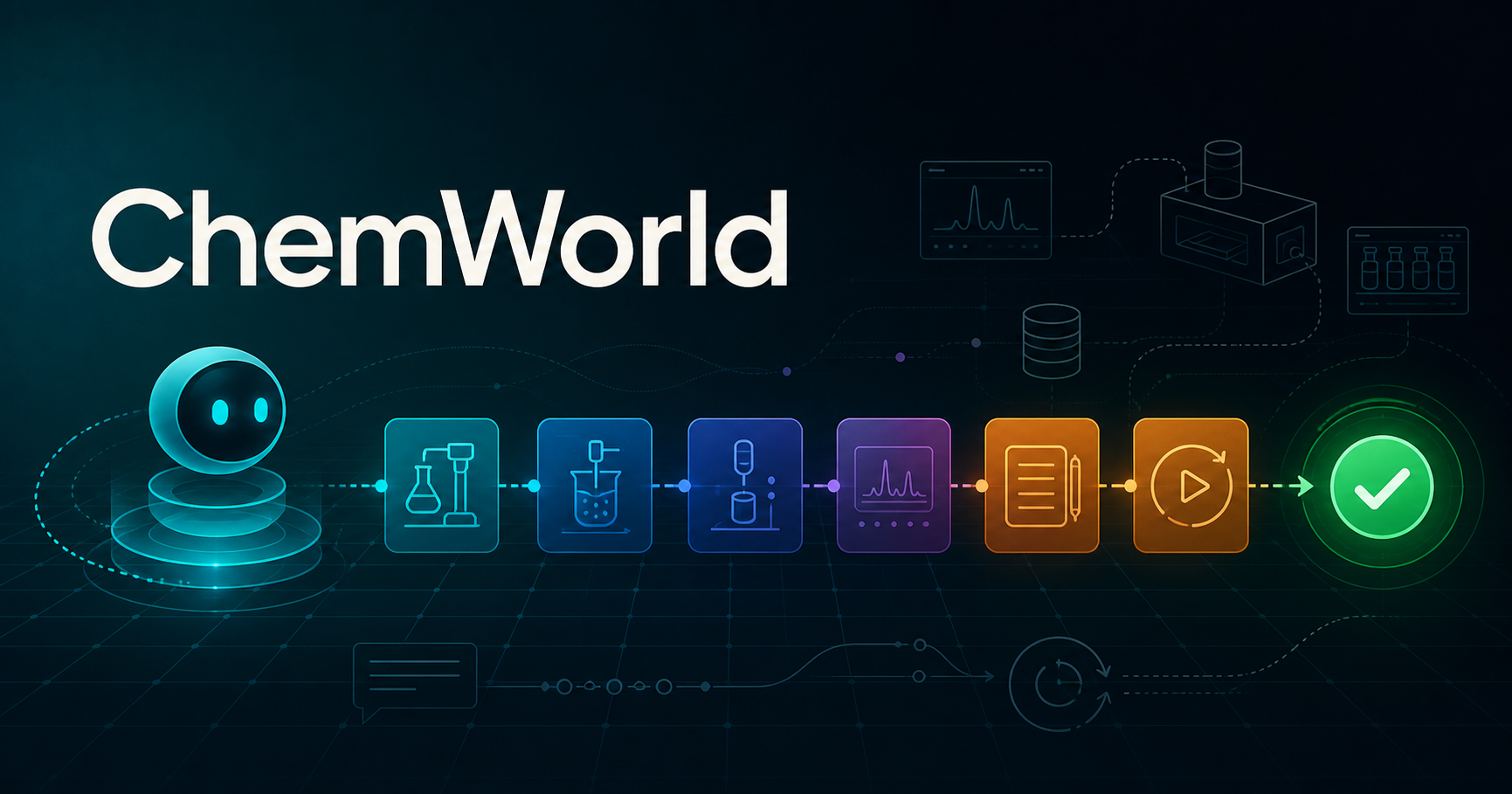
The research question
Language models can describe an experiment. But can an agent decide what remains unknown, acquire the right evidence, operate under constraints, revise a failing plan and finish the experimental lifecycle? ChemWorld makes that question executable.
| Static benchmark | Interactive chemical world |
|---|---|
| A fixed prompt contains the evidence. | Measurements are actions with cost, time and sample consequences. |
| Correctness is judged at one output. | Every legal and invalid operation changes—or deliberately does not change—the trajectory. |
| New examples test input generalization. | Controlled world forks test whether strategy adapts when causal rules change. |
One system, three layers
Physical causal world
Typed state, hidden dynamics, equipment, instruments and controlled interventions.
Experimental runtime
Validation, transactions, measurements, failures, resources, lifecycle and replay.
Task and evaluation
Public goals, permissions, budgets, termination and task-specific outcomes.
What is verified in Public v0.4
These are finite software-model qualification results. They establish the published contracts and replay boundary; they do not establish an Agent ranking, universal chemical fidelity or physical-laboratory transfer. Inspect the evidence →
Choose a path
| Goal | Start here |
|---|---|
| Operate a task in the browser | Live Student Lab |
| Step through built-in policies | Agent Observatory |
| Understand the research thesis | Why ChemWorld |
| See how hidden causal rules change | Causal Worlds |
| Connect your own policy or model | Build an Agent |
| Design a reproducible comparison | Benchmark Design |
Development-frontier features and unpublished evidence remain in the ChemWorld development repository; this site documents only the stable public release.